
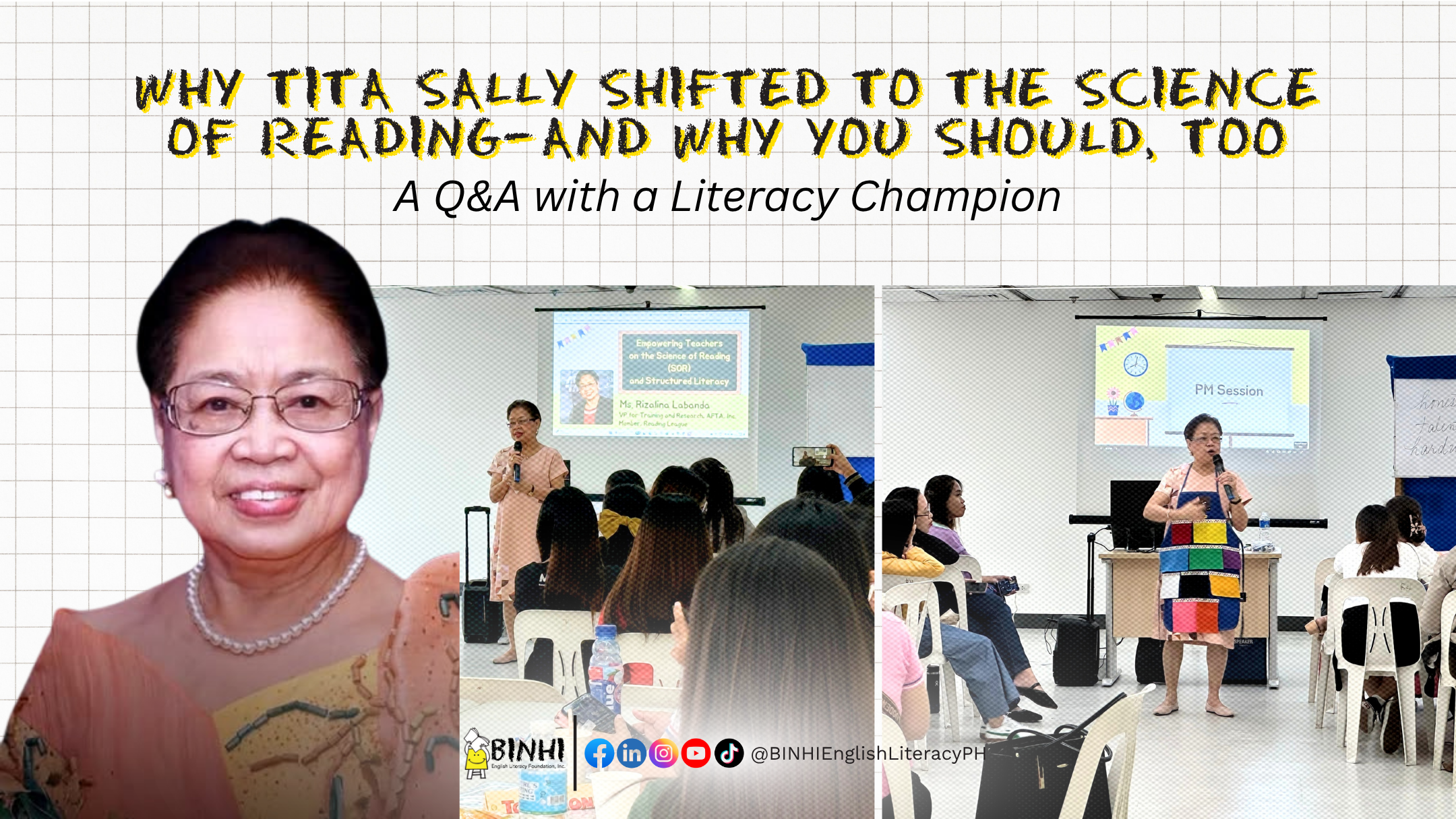
Meet Rizalina Labanda or Tita Sally. With over 50 years of classroom experience, she was a longtime advocate of Whole Language (WL) instruction. But when she discovered the Science of Reading (SoR), she made a pivotal shift. She realized that learning to read isn’t a natural process like speaking; the brain must be explicitly and systematically wired to map sounds to letters. Today, Tita Sally serves as BINHI’s go-to resource speaker for teacher training, helping public school educators transition to evidence-based instruction.
In this exclusive Q&A, Tita Sally breaks down why structured literacy is the key to closing the reading gap for students. From building strong foundational decoding skills in the early grades to preventing the “silent dropout” in upper elementary, her insights show how we can safeguard every child’s right to literacy. When we teach the way the brain actually learns, we ensure no learner gets left behind.
1. Can you tell us about yourself and your background in education and literacy?
I’m retired but not tired, I have 5 decades of teaching high school, college, elementary and middle grades. A high school teacher of English by profession but found my love teaching early grades. I was a Whole Language (WL) & Balanced Literacy (BL) advocate but realized I had to make a mind shift teaching reading when I met Science of Reading.
2. What first inspired you to focus on the Science of Reading?
In 2013 when I went back to the USA to finish my 10 years of teaching to earn my SSS retirement, I was introduced to SoR when my principal at Blessed Sacrament Catholic Academy (BSCA) sent me to seminars on brain research. It took me 5 years to embrace SoR because I was a Whole Language advocate. I realized that I have made a lot of mistakes in most seminars I have given based on the psycholinguistic principles behind Whole language & Balance Literacy. It boils down to frustration with what doesn’t work, seeing what does work, and realizing who gets left behind if I don’t act. I was told “Kids learn to read naturally,’’ or ‘’Don’t correct decoding, it kills love of reading.’’ I found out that there were 50 years of cognitive science that were nerve taught.
3. How did your previous Science of Reading training with BINHI go, and what impact did you hope it would create?
The training went well, at least on the awareness level, that there is a Science of Reading. Teachers learned that they need to stop teaching reading instruction like a matter of opinion, style, or tradition. We have evidence – based solutions. Being aware of SoR means:
Being aware of SoR means knowing that reading is a skill we can teach every child if we teach it the way the brain learns explicitly, systematically & early.
4. What key ideas about the Science of Reading do you believe teachers should understand most?
SoR doesn’t kill the love of reading. It makes it possible. Kids don’t fall in love with books they cannot read.
5. Why do you think this approach is important for Filipino children and their reading development?
SoR structured literacy is important to Filipino children and their development because:
6. Why do you work with BINHI?
Because we are working on the same page. BINHI believes in SoR. I believe BINHI can be a change maker. Also, BINHI provides support to teachers in order to help children become readers and future leaders.
7. What motivates you to keep advocating for literacy?
Striving for the Science of Reading is about honoring every child’s fundamental right to literacy through methods backed by decades of cognitive research study. Reading is not a natural process; it is a learned skill that requires explicit, systematic instruction to rewire the brain and unlock the sound-symbol code. When educators shift to evidence-based structured literacy, instruction becomes a guaranteed foundation for equitable learning. By mastering decoding early, students gain the tools and confidence to access complex texts, bridging academic gaps, and giving every child—regardless of background—the power to read, learn, and succeed.